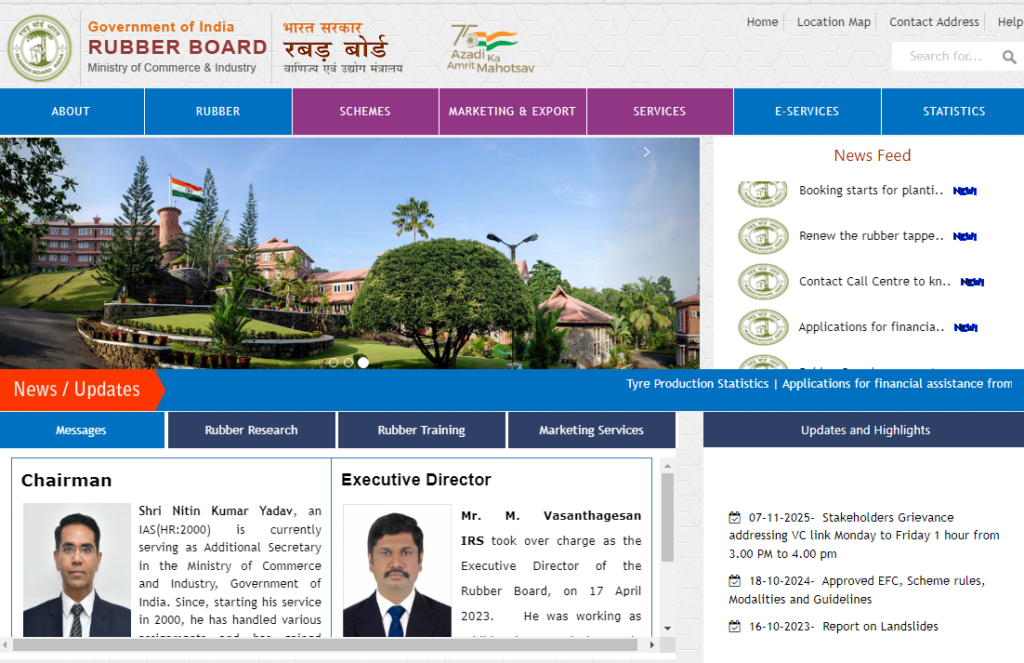
The Rubber Board of India, under the Ministry of Commerce and Industry, conducts recruitment for various technical and administrative positions, most notably the Field Officer and Rubber Organizer. To succeed in these competitive exams, candidates must have a clear understanding of the latest syllabus and the weightage of different sections.
Whether you are an Agriculture graduate or a General stream applicant, the 2026 Rubber Board Exam requires a strategic approach focusing on both core subject knowledge and general aptitude.
Rubber Board Recruitment 2026: Selection Process
The selection process for most Group C and Group B (Non-Gazetted) posts in the Rubber Board follows a two-stage evaluation:
- Written Examination (CBT): An objective-type test conducted in a Computer-Based Test (CBT) mode.
- Document Verification: Candidates who clear the cutoff in the written exam are called for certificate verification.
- Medical Examination: Final selection is subject to being found medically fit.
Note: There is generally no personal interview for Group C posts like Field Officer.
Rubber Board Exam Pattern 2026
The exam usually consists of a single paper divided into two parts: Part A (General Aptitude) and Part B (Subject Specific).
| Section | Subject | Number of Questions | Total Marks | Duration |
| Part A | General Awareness, Reasoning, English & Maths | 50 | 50 | 120 Minutes |
| Part B | Core Subject (Agriculture/Botany/Science) | 50 | 50 | (Combined) |
| Total | — | 100 | 100 | 2 Hours |
Marking Scheme:
- Each correct answer carries 1 Mark.
- Negative Marking: 0.25 marks are deducted for every wrong answer.
Detailed Rubber Board Syllabus: Subject-Wise Topics
1. General Awareness & Current Affairs
This section tests the candidate’s knowledge of recent events and general knowledge about India.
- National & International Events: Awards, Summits, and Sports.
- Indian Economy: Specifically related to the plantation sector and agriculture.
- History & Geography: Focus on South India (where rubber plantations are prominent).
- Government Schemes: Schemes related to farmers, MSME, and rural development.
2. Reasoning & Mental Ability
- Verbal Reasoning: Syllogism, Blood Relations, Coding-Decoding.
- Non-Verbal Reasoning: Series completion, Mirror Images, Paper Folding.
- Analytical Reasoning: Seating arrangements and Puzzles.
3. Quantitative Aptitude (Basic Mathematics)
- Number Systems & Simplification.
- Percentage, Ratio, and Proportion.
- Profit & Loss, Simple & Compound Interest.
- Data Interpretation (Charts and Tables).
4. Core Subject: Agriculture/Botany (For Field Officer)
This is the most critical section for the Field Officer post.
- Plantation Crops: Cultivation practices of Natural Rubber (Hevea brasiliensis).
- Soil Science: Soil fertility, fertilizers, and nutrient management in rubber plantations.
- Plant Pathology: Common diseases of rubber trees (e.g., Abnormal Leaf Fall, Powdery Mildew) and their control.
- Crop Physiology: Growth regulators, Tapping systems, and Latex processing.
- Agricultural Extension: Training programs for rubber growers and cooperative societies.
Preparation Strategy for Rubber Board Exam
- Focus on Rubber Statistics: Be thorough with data regarding rubber production in India, major rubber-producing states (Kerala, Tripura), and the role of the Rubber Board.
- Master Part B: Since 50% of the paper is subject-specific, use standard Agriculture/Botany textbooks. Pay special attention to “Latex Technology” and “Tapping Methods.”
- Mock Tests: Practice previous year question papers to get a feel for the time management required for the 120-minute window.
- Current Affairs: Read the “Rubber Statistical News” or the Rubber Board’s monthly bulletins for the latest industry updates.
Important Links for Rubber Board Aspirants
| Resource | Link |
| Download Syllabus PDF | Rubber Board Official Syllabus |
| Previous Year Papers | Practice Question Bank |
| Official Website | rubberboard.gov.in |
Frequently Asked Questions (FAQs)
Q: Is the syllabus same for Rubber Organizer and Field Officer?
A: No. While Part A (General Aptitude) is similar, Part B for Rubber Organizer focuses more on administrative and rural management topics, whereas Field Officer focuses on Agriculture and Botany.
Q: In which language is the exam conducted?
A: The question paper is usually bilingual (English and Hindi).
Q: Does the Rubber Board provide study material?
A: The Rubber Board does not provide an official “guide,” but their publication “Rubber and its Cultivation” is highly recommended for the technical section.
🌐 Stay Connected with different social platforms of AapkaJobAlert! Because it’s not possible to place all job at one place as a Scientist and my team puts information at different platforms for big private company/ experience jobs / PSU/ Government Jobs/ internship/Scholarship. In larger Private company Application forms date, Interview date etc they give very less so Aspirants regret of not applying because of missing last date.
Never miss an important job update. Follow us across all our official platforms to stay ahead in your career!!
📍 Official Website:
https://aapkajobalert.com
📱 Join our Telegram:
https://t.me/aapkajobalert
✅ WhatsApp Channel:
https://whatsapp.com/channel/0029Vb7r39y8V0tkZGH3Q60k
📸 Follow on Instagram:
https://www.instagram.com/aapkajobalert?igsh=NGU4NWVoc25mZWw1
🐦 Follow on X (Twitter):
https://x.com/AapkaJobAlert
👤 Like us on Facebook:
https://www.facebook.com/share/1DaHpCqsrp/
📧 General Inquiries:
info.aapkajobalert@gmail.com
📧 Business Inquiries:
info@aapkajobalert.com
#AapkaJobAlert #GovtJobs #JobUpdates #CareerNews #Hiring2026 #JobSearch #EmploymentNews